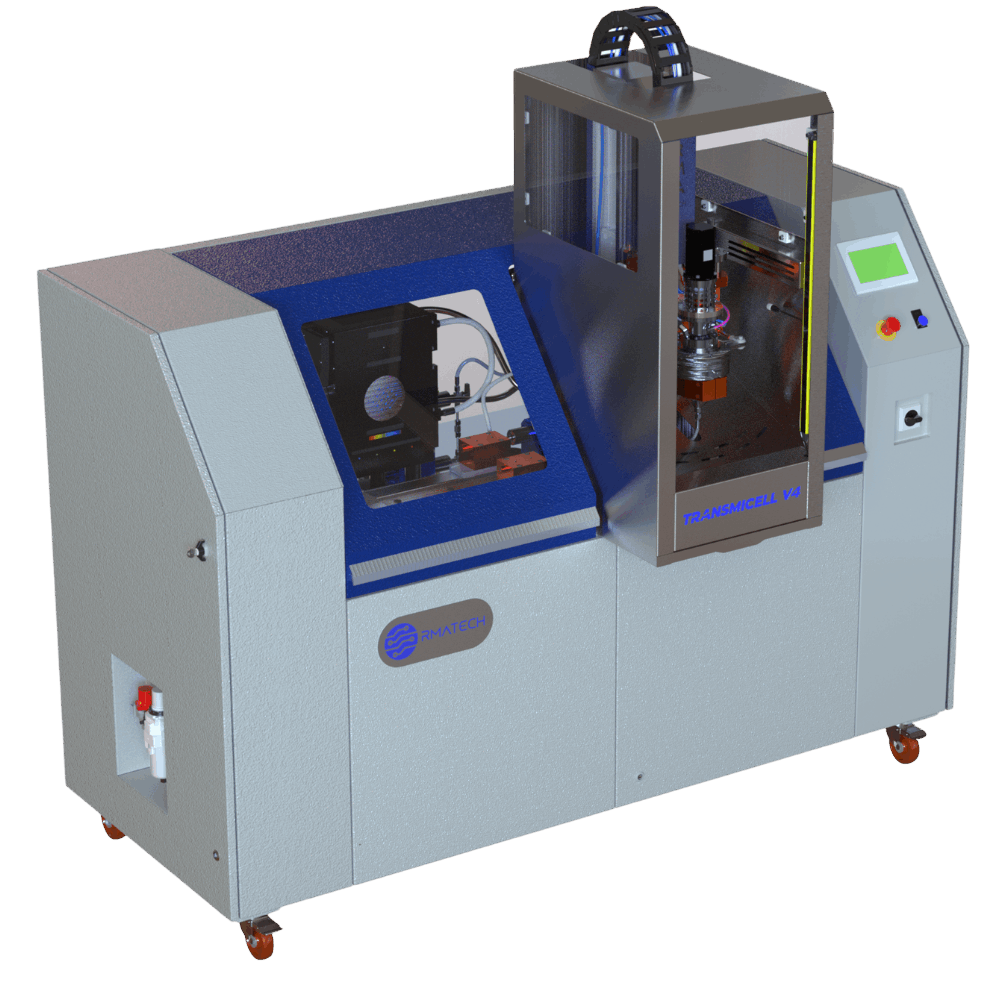
TRANSMICELL® V4

Wet tinting strength and hiding power measurement, by transmission
The new TRANSMICELL® V4

Advanced wet transmission analysis platform

TRANSMICELL® V4 automatically measures tinting strength, wet hiding power and dispersion progress directly in the liquid sample, for both waterborne and solventborne systems.

The measurement is objective, with no white base, no drawdown and no drying: about 1 minute per reading, with automatic cleaning in 5 minutes.

CE compliant and already in operation in Europe.

TRANSMICELL® V4 – espectrofotômetro de transmissão em via úmida da RMA TECH

From the lab to production: the first step towards Paint Industry 4.0

With the conventional method, tinting strength depends on weighing, let-down with a white base, application, drying and a reflectance reading. That means many steps, a long lead time and an operator-dependent result.

TRANSMICELL® V4 replaces this process with wet transmission measurement: the light beam passes through the liquid sample and produces a spectral curve, compared against a reference standard measured under identical analytical conditions. The result is the spectrum of the pure pigment, with much higher sensitivity across the entire visible range.

Patented technology: WO 2020/093121 A1 | EP 3 879 258 B1 | US 11,835,448 B2.

tra-01

No white base

Analyzes the pure pigment, with no white let-down base and no secondary standards. Eliminates weighing, application and drying errors.

tra-02

Productivity

About 1 minute per reading and automatic cleaning in 5 minutes. At an industrial coatings customer, total adjustment time dropped from 395 to 40 minutes (−90%).

tra-03

Precision

Gage R&R of 9.13% (V3/V4): rated “excellent” under AIAG MSA (4th ed.) and about 5 times better than the conventional method.

tra-04

Automation

Fully automated measurement, dilution, cleaning and calibration, with no operator dependency. Architecture ready for integration with process automation.

tra-06

Lab and process

At-line use in the QC lab, with a path to in-line control through TRANSFLOW 4.0®, connecting raw materials, dispersion and batch approval.

tra-05

Savings

Optimized grinding end point, less over-grinding and lower energy consumption. At customers: up to 67% fewer adjustment additions and 50% shorter process lead time.

WHAT'S NEW IN V4

What's new in TRANSMICELL® V4

1. Waterborne or solventborne

Automatic configuration between waterborne and solventborne systems, with no manual setup change between analyses.

2. Variable GAP from 50 to 4000 µm

Optical path adjustable to any value between 50 and 4000 µm, light power from 1x to 500x and automatic dilution with high-precision dosing syringes. The analytical condition adapts to each material.

3. Up to 3 different vehicles

Three tanks for waterborne or solventborne vehicles, one transition solvent and two machine cleaning solvents. More product types analyzed on the same instrument.

4. Automatic cleaning and CE compliance

Automatic cleaning system with ejector and direct sample discharge valve. CE compliant equipment.

Request a TRANSMICELL® V4 demonstration and see the results with your own samples.

Frequently Asked Questions

Tinting strength is the ability of a pigment, concentrate or colorant to impart color to a paint. It is a key quality test for automotive, industrial and decorative colorants and concentrates, and ensures the right final color when colorants are combined.

It ensures batch-to-batch consistency. In tinting systems and refinish, colorants are combined by formula; if tinting strength varies, the final color varies. In the plant, bases and concentrates with controlled tinting strength mean fewer adjustments, less rework and shorter cycle times.

With the conventional method, the colorant is mixed with a white base, applied to a panel, dried and read by reflectance: a long process, sensitive to weighing, application and drying variations.

TRANSMICELL® V4 measures by transmission directly in the liquid sample, with no white base: about 1 minute per reading, fully automated, with a Gage R&R of 9.13%. The same principle measures wet hiding power and tracks grinding progress.

Materials analyzed: organic and inorganic pigment concentrates and dispersions, TiO₂ and extender slurries (CaCO₃, dolomite, talc, silica), base coats, architectural, industrial and automotive paints, wood stains, metallic and pearlescent effect bases and tinted clear coats.